
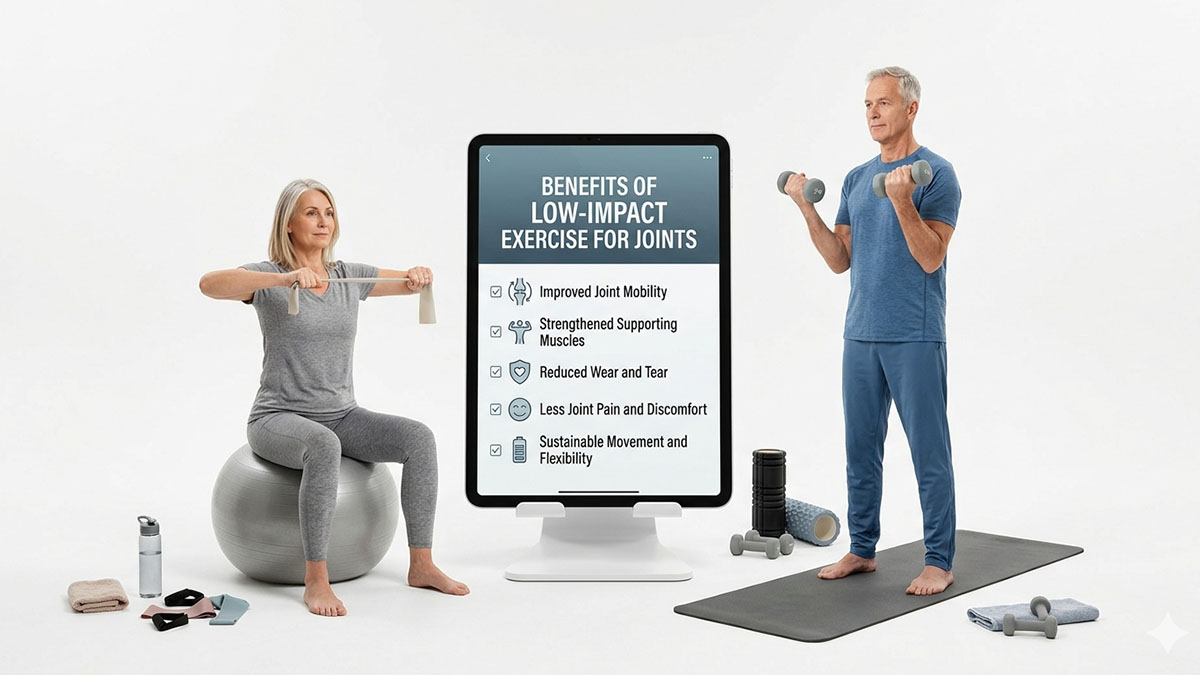
When many people think about getting fit, they picture intense scenes of sprinting on hard pavement, jumping high into the air, or lifting massive weights that make their knees buckle. While these high-intensity activities have their place, they can often be a nightmare for your joints. If you have ever felt a sharp twinge in your hip after a run or noticed your knees clicking and aching after a high-energy aerobics class, you are not alone. Our joints are the biological hinges that keep us moving, but they are not indestructible. Over time, the constant pounding of high-impact exercise can wear down cartilage and lead to chronic inflammation. This is exactly why more people are turning to low impact workouts for joint health. These exercises provide all the cardiovascular and strength-building benefits of traditional workouts but without the punishing stress on your skeletal system. By choosing to move mindfully, you can build a body that is strong, lean, and most importantly pain-free.
The concept of low impact exercise is simple: it involves movements where at least one foot stays on the ground at all times, or where the body is supported in a way that minimizes jarring forces. Think of it as the difference between a hammer hitting a nail and a gentle wave washing over the shore. When you engage in low impact workouts for joint health, you are protecting the delicate cushions between your bones, known as the synovial fluid and cartilage. This is especially important as we age, as our bodies naturally become less efficient at repairing joint tissue. However, low impact is not a synonym for “easy.” You can still sweat, burn hundreds of calories, and reach a high heart rate without ever having to jump or lunge violently. It is about working smarter, not necessarily harder, to ensure your body lasts a lifetime.
One of the most effective and popular forms of low impact workouts for joint health is swimming and water aerobics. Water is a magical environment for the human body because of buoyancy. When you are submerged up to your chest, the water supports about 90% of your body weight. This means your joints are suddenly freed from the constant pull of gravity. You can perform complex movements, kick your legs, and rotate your shoulders with a range of motion that might be impossible on land. Swimming laps is a fantastic way to build a strong heart and toned muscles, but even walking in the water provides natural resistance that strengthens your legs without any impact. For anyone suffering from arthritis or recovering from an injury, the pool is often the safest and most productive place to rebuild fitness.
Walking is perhaps the most underrated entry on the list of low impact workouts for joint health. It is the most natural movement for humans, and yet we often overlook it in favor of “fancier” exercises. Brisk walking increases your heart rate and strengthens your lower body, but the force applied to your ankles and knees is significantly lower than that of running. If you want to increase the challenge without adding impact, you can try “power walking” with exaggerated arm movements or find a gentle incline. Walking outdoors also has the added benefit of uneven terrain, which helps strengthen the small stabilizer muscles around your ankles and knees, providing better support for your joints in everyday life. It is an accessible, free, and highly effective way to stay active every single day.
Cycling is another powerhouse in the world of joint-friendly fitness. Whether you prefer a stationary bike in your living room or a mountain bike on a forest trail, cycling is a closed-circuit movement. This means your feet stay in a fixed position on the pedals, and the circular motion allows your knees to move through a full range of motion without the “shock” of hitting the ground. Many physical therapists recommend cycling for people recovering from knee surgery because it helps circulate synovial fluid, which lubricates the joint. To maximize the low impact workouts for joint health benefits of cycling, ensure your seat height is adjusted correctly; a seat that is too low can put unnecessary pressure on the front of the knee. When done right, cycling builds incredible quadriceps and glute strength, which further protects the knee joints by absorbing the forces of daily walking.
Yoga and Pilates are essential components of any joint-health strategy. While they are often grouped together, they offer slightly different benefits. Yoga focuses on flexibility, balance, and isometric strength. By holding poses, you strengthen the muscles around the joints, creating a sort of “internal brace” that keeps everything aligned. On the other hand, Pilates focuses heavily on core strength and controlled, fluid movements. A strong core is vital for joint health because it takes the pressure off your lower back and hips. When your midsection is stable, your limbs can move more efficiently, reducing the wear and tear on your extremities. Both practices emphasize the mind-body connection, teaching you to listen to your joints and stop before a movement becomes painful.
Elliptical trainers and rowing machines are the kings of the gym for those seeking low impact workouts for joint health. An elliptical machine mimics the motion of running but keeps your feet on pedals that move in a smooth, oval path. You get the heart-pumping benefits of a jog without your feet ever leaving the machine, which eliminates the impact phase entirely. Rowing machines are equally impressive, providing a full-body workout that engages 86% of your muscles. Because you are seated, your weight is supported, and the resistance is generated by your own pulling power. It builds a strong back, powerful legs, and a resilient heart, all while being incredibly kind to your knees and hips.
Consistency and variety are the final pieces of the puzzle. To get the most out of low impact workouts for joint health, you should try to mix different activities throughout the week. For example, you might swim on Mondays, take a yoga class on Wednesdays, and go for a long walk on Saturdays. This variety ensures that you are not overusing one specific joint and that you are challenging your body in different planes of motion. It is also important to remember that nutrition and hydration play a supporting role. Drinking plenty of water keeps your joint tissues hydrated, and eating a diet rich in omega-3 fatty acids can help reduce the inflammation that often leads to joint pain.
In conclusion, you do not have to beat your body up to get in shape. The philosophy of “no pain, no gain” is outdated and often dangerous for long-term mobility. By embracing low impact workouts for joint health, you are making a conscious decision to respect your body’s limits while still pushing your physical boundaries. You are choosing a path that allows you to be active not just today, but twenty, thirty, and forty years from now. Whether you are gliding through the water, pedaling through the park, or stretching on a yoga mat, every low-impact movement is an investment in a future where you can move freely and joyfully. Start small, listen to your body, and enjoy the feeling of getting stronger without the ache.